
by James Whitelock | May 19, 2025 | Insights
The New Rules of Agency Growth
In an AI-infused talent landscape, the traditional growth playbook for SME recruitment agencies is no longer fit for purpose. Increasingly, agency leaders are shifting from a pure sales-led model to one that integrates brand building and sustained marketing investment.
As Matt Alder, host of the Recruiting Future podcast, puts it: “Recruitment marketing is no longer a nice-to-have. It’s the key differentiator in a commoditised market.” Agencies must now attract not only clients but also increasingly elusive, brand-savvy candidates.
Key Drivers Reshaping the Landscape:
- Candidate Empowerment: According to LinkedIn Talent Trends, 74% of candidates research an agency’s brand before applying. They scrutinise online reviews, social media presence, and company values. A poor digital footprint can deter top talent.
- Demand for Authenticity: Candidates trust employees more than brands. Peer-driven platforms such as Glassdoor, and content shared by employees on LinkedIn, now heavily influence perception.
- Digital Discovery: 61% of hiring journeys now start online, with candidates engaging with content long before they submit an application (Smart Insights, 2024).
Comparison of Traditional vs Modern Recruitment Approaches
| Feature |
Traditional Model |
Modern Model |
| Outreach Method |
Cold calling |
Content marketing & inbound lead gen |
| Lead Tracking |
Manual / spreadsheets |
Integrated CRM and analytics |
| Employer Brand Visibility |
Minimal |
Central to attraction strategy |
| Time-to-Hire |
Longer |
Shortened through nurture automation |
| Candidate Experience |
Transactional |
Personalised and data-informed |
Common Challenges:
- Most SMEs lack dedicated in-house marketing capability
- Founders view marketing as a discretionary cost rather than a strategic investment
Recommended Approach:
- Appoint a marketing lead – this can be internal or an outsourced partner
- Define measurable marketing KPIs aligned to business objectives such as:
- Leads generated per channel
- Cost-per-hire
- Time-to-fill
- Source-to-hire ratio
Start by assigning a marketing lead (internal or outsourced) and defining success metrics aligned to your business model: leads generated, cost-per-hire, brand awareness uplift.
Key Drivers Reshaping the Landscape:
- Candidate Empowerment: According to LinkedIn Talent Trends, 74% of candidates research an agency’s brand before applying. They scrutinise online reviews, social media presence, and company values. A poor digital footprint can deter top talent.
- Demand for Authenticity: Candidates trust employees more than brands. Peer-driven platforms such as Glassdoor, and content shared by employees on LinkedIn, now heavily influence perception.
- Digital Discovery: 61% of hiring journeys now start online, with candidates engaging with content long before they submit an application (Smart Insights, 2024).
Comparison of Traditional vs Modern Recruitment Approaches
| Feature |
Traditional Model |
Modern Model |
| Outreach Method |
Cold calling |
Content marketing & inbound lead gen |
| Lead Tracking |
Manual / spreadsheets |
Integrated CRM and analytics |
| Employer Brand Visibility |
Minimal |
Central to attraction strategy |
| Time-to-Hire |
Longer |
Shortened through nurture automation |
| Candidate Experience |
Transactional |
Personalised and data-informed |
Common Challenges:
- Most SMEs lack dedicated in-house marketing capability
- Founders view marketing as a discretionary cost rather than a strategic investment
Recommended Approach:
- Appoint a marketing lead – this can be internal or an outsourced partner
- Define measurable marketing KPIs aligned to business objectives such as:
- Leads generated per channel
- Cost-per-hire
- Time-to-fill
- Source-to-hire ratio
Defining ROI in Recruitment Marketing
Recruitment marketing ROI is the measure of how effectively marketing initiatives contribute to business growth, typically by generating more qualified leads, improving brand awareness, and ultimately increasing placements and revenue.
ROI Calculation Formula:
This formula is best applied to longer-term, multi-touch recruitment campaigns that influence both client and candidate pipelines.
Key Metrics and Definitions:
- Cost per Lead (CPL): The average amount spent to generate a marketing-qualified lead. For SMEs, this typically ranges from £50 to £120 depending on channel (Smart Insights, 2023).
- Cost per Hire (CPH): Agencies focused on brand-building and candidate experience tend to reduce CPH by up to 30% due to improved engagement and reduced drop-off (Glassdoor, 2022).
- Lead-to-Revenue Conversion Rate: High-performing firms convert between 10% and 25% of MQLs into revenue-generating placements.
- Lifetime Value (LTV): Captures repeat revenue generated from clients or candidates engaged via marketing.
CPL and CPH Trends by Channel

Common Challenges:
- Short-term campaign thinking that fails to track long-term brand impact
- Siloed systems – marketing, sales, and recruitment teams not sharing data
Recommendations:
- Use tools such as HubSpot, LogicMelon, and Google Data Studio to create real-time dashboards
- Track conversions over time, not just direct attribution
- Consider both quantitative (CPL, CPH) and qualitative (brand sentiment, candidate NPS) ROI indicators
ROI Levers: Where Value Is Created
1. Content Marketing & Employer Branding
Content-led strategies that educate, inform, or inspire consistently drive deeper engagement. For example, ‘day in the life’ videos or employee interviews humanise the brand, attracting higher quality applicants.
Example: An engineering recruitment agency created a blog series profiling client projects and team culture. Organic traffic grew by 200% in 6 months, and 30% of placements were from inbound applications.
2. Job Distribution & SEO
Automated job distribution platforms and SEO optimisation ensure roles reach a wider, more relevant audience.
Validation: Agencies using SEO best practices for job posts (keyword inclusion, schema markup, mobile responsiveness) receive up to 3x more traffic than those relying on third-party boards alone (LogicMelon, 2023).
3. CRM & Automation
Implementing a recruitment CRM allows agencies to segment, score, and nurture leads effectively.
Stat: Silver medalist candidates who receive nurture emails are 35% more likely to reapply within 90 days (Talent Works, 2023).
4. Paid Advertising
When targeted correctly, paid campaigns can deliver fast, scalable results.
Example: A finance recruitment agency achieved a 7:1 ROI from a series of LinkedIn Sponsored Content campaigns focused on attracting mid-level accountants in Greater London.
5. Measurement and Analytics
Understanding which touchpoints influence decisions helps agencies scale what works and eliminate what doesn’t.
Recommendation: Implement full-funnel attribution to see which pieces of content or channels contribute most consistently to conversions.
Budget Allocation: What Top Firms Spend
High-performing SME agencies commit between 5% and 10% of their annual turnover to marketing. Underperforming agencies often invest less than 2%, resulting in slower growth.
Budget Allocation Table:
| Category |
Recommended % of Budget |
Purpose |
| Paid Media & Outsourcing |
45% |
Awareness and lead acquisition |
| Content & Brand |
25% |
Long-term brand equity and trust |
| Martech & Platforms |
20% |
Automation, CRM, analytics |
| Consultancy / Support |
10% |
Strategy, campaign execution, content creation |
“It’s not about how much you spend, but how well you connect with your audience at every stage of the journey.” — Meghan M. Biro, TalentCulture
Media Mix Strategy
A balanced approach using Paid, Owned, and Earned media increases visibility and credibility across the candidate and client journey.
Paid Media:
- Includes Google Ads, LinkedIn campaigns, programmatic job advertising
- Delivers fast reach, but requires precise targeting and good landing page experience
- Tip: Begin with remarketing campaigns and low-risk A/B tests
Owned Media:
- Your website, blog, talent CRM, email list
- Builds long-term brand authority and trust
- Tip: SEO-optimised careers pages and high-value content improve conversion rates dramatically
Earned Media:
- Includes press mentions, employee advocacy, candidate testimonials
- Builds organic trust and expands reach through third parties
- Tip: Empower consultants to share relevant insights on LinkedIn
Cost vs Trustworthiness of Media Types

Measurement Models: Tools & Attribution
Attribution Models Overview:
| Model |
Best For |
Limitation |
| First Click |
Awareness campaigns |
Ignores middle and end of journey |
| Last Click |
Immediate conversions |
Ignores early nurturing efforts |
| Linear |
Multi-touch journeys |
Assumes equal weight per touch |
| Time Decay |
Weighted for recent actions |
Underplays top-of-funnel influence |
| Data-Driven |
AI-powered path modelling |
Requires significant data volume |
Recommended Tools:
- Google Analytics 4 (GA4): Set up goals, events, conversion paths
- AI Driven CRM: Track lead lifecycle and campaign influence
- AI Driven ATS: Specific to recruitment – source-to-hire and job ad tracking
“You can’t manage what you can’t measure.” — Peter Drucker
Common Mistakes:
- Attribution blindness: No tracking beyond the job ad.
- Ignoring dark social and candidate sentiment
Recommendation:
Adopt at least a linear attribution model and integrate your CRM with marketing analytics. Start simple, then evolve.
Mistakes to Avoid
- Treating Marketing as a Campaign, Not a System
- Marketing should be always-on, not reactive.
- Lack of Strategy
- Tactical execution without clear ICP or value proposition.
- Over-Reliance on Paid Ads
- Sustainable growth requires brand equity, not just clicks.
- Inconsistent Messaging
- Fragmented brand voice across platforms confuses both clients and candidates.
- Ad-Hoc Campaigns:
- Recruitment marketing must be always-on, not reactive
“The biggest mistake is thinking you can market like a big agency without a strategy.” — Hung Lee, Recruiting Brainfood
Recommendation:
Audit your current activity. Ask: Does it align with our goals? Is it repeatable? Is it measured?
Case Studies
- Boutique Tech Recruiter – Manchester
- Monthly spend: £1,500 on LinkedIn
- Outcome: 128 qualified applicants, 12 hires
- ROI: 380% based on gross profit from placements
- Life Sciences Specialist – Cambridge
- Strategy: Email nurture + thought leadership content
- Result: 3x increase in CV submissions, 24% referral boost
- Startup Recruiter – Bristol
- Strategy: Full outsourced marketing partner
Year 1: Scaled to £250k GP via inbound client and candidate traffic
From Basics to Advanced
Getting Started:
- Define candidate, client, and referrer personas
- Send a monthly email newsletter with roles and insights
- Test a £500 LinkedIn campaign with clear targeting
Next Steps:
- Create a content calendar aligned to job categories and FAQs
- Automate nurture journeys for cold and warm candidates
- Launch internal employee advocacy programme
Advanced Strategies:
- Integrate GA4 and CRM for full-funnel tracking
- Conduct candidate NPS surveys to assess brand perception
- Produce testimonial videos and journey mapping to improve experience
“There is no silver bullet, just a collection of smart, consistent tactics done well.” — David Green, myHRfuture
Conclusion
Recruitment marketing is not a cost – it is a revenue generator. For SME recruitment agencies, embedding a structured, measurable marketing system can drive sustainable growth, reduce cost-per-hire, and differentiate in a crowded marketplace. Agencies that commit to consistent, brand-led marketing strategies not only attract better candidates but also win more loyal clients. The data is clear: those who invest in marketing, win.
References
About ThinkinCircles
ThinkinCircles is a specialist recruitment marketing and employer branding agency dedicated to helping recruitment agencies, in-house talent teams, and RecTech providers grow through intelligent, data-driven marketing.
Acting as an outsourced in-house marketing partner, Think in Circles combines strategic thinking with hands-on execution to elevate brands, generate qualified leads, and improve candidate and client engagement across every channel.
We’re not just about ‘doing marketing’—we help recruitment businesses:
- Identify and communicate their unique value propositions
- Build consistent, scalable lead pipelines
- Enhance employer brand visibility
- Leverage content, automation, and analytics to drive performance
Whether you’re a scaling agency or an established player ready to refresh your marketing model, Think in Circles helps you connect the dots between marketing activity and measurable commercial results.

by Richard Blamire | May 15, 2025 | Insights, News
(And What You Risk If You Don’t)
In today’s competitive hiring market, recruitment marketing has become an essential part of attracting and converting top talent. But here’s the reality: many recruitment businesses, agencies, and in-house talent teams are still trying to juggle this complex task using overstretched internal resources – or worse, without any clear strategy at all.
Outsourcing your recruitment marketing isn’t just a nice-to-have. It can be the difference between consistent candidate flow and total pipeline paralysis. Here’s why outsourcing works—and the pitfalls of trying to do everything in-house.
The Hidden Costs of Keeping Recruitment Marketing In-House
1. You’re Asking Too Much of Too Few People
Often, recruitment businesses will assign marketing responsibilities to someone already wearing multiple hats – maybe it’s a recruiter who “gets LinkedIn” or an admin who’s “good with Canva.” The result? Inconsistent messaging, unclear targeting, and campaigns that never get off the ground.
In-house marketers, especially those without recruitment-specific experience, often find themselves overwhelmed. They’re expected to:
-
Create compelling job ad copy
-
Build employer brand content
-
Run PPC and social campaigns
-
Manage email sequences
-
Improve SEO
-
Track analytics and report on ROI
No single person can master all these skills—at least not well.
2. You Miss Opportunities by Being Reactive
When you’re bogged down in daily recruitment tasks, marketing becomes reactive. Campaigns go out late. New channels are ignored. Careers pages sit untouched for years. Meanwhile, competitors who do have a proactive marketing engine are grabbing the attention (and loyalty) of your ideal candidates.
3. You Spend More for Less Impact
Hiring in-house can be expensive, especially if you’re looking for someone with experience in content, paid media, branding, and data. And even if you find that unicorn, you still need to invest in training, tools, and time. With outsourcing, you get a whole team of specialists, often for less than the cost of one full-time employee.
4. You’re Flying Blind Without Strategy
A lot of recruitment marketing fails because it’s not guided by a proper strategy. It’s driven by instinct, not data. And without understanding your employer value proposition (EVP), candidate personas, funnel stages, and competitive landscape, even the best creative assets will fall flat.
Why Outsourcing Recruitment Marketing Works
Outsourcing gives you instant access to a specialist team that knows how to market in the recruitment and talent space. Here’s how it benefits you:
1. Deep Industry Expertise
Agencies or fractional marketing partners who specialise in recruitment understand your world – ATS platforms, DEI challenges, sourcing bottlenecks, EVP messaging, and candidate journey mapping. This means faster ramp-up time, smarter campaigns, and better alignment with your hiring goals.
2. On-Demand Scalability
Whether you’re ramping up for a seasonal hiring blitz or launching a new recruitment campaign, outsourced teams flex with your needs. You can scale up during busy periods or scale back when needed, without the headaches of hiring or downsizing.
3. More Strategic Thinking
Good marketing partners don’t just execute—they think. They challenge your assumptions, identify gaps in your messaging, improve your employer brand positioning, and help build long-term strategies that reduce time-to-hire and cost-per-acquisition.
4. Access to Tools and Tech
An outsourced recruitment marketing partner will already have access to the right martech stack—from analytics and automation to AI-powered tools—saving you thousands on subscriptions and licences.
5. Fresh, Objective Perspective
It’s easy to get stuck in your own internal echo chamber. External marketing partners bring objectivity. They see your brand the way candidates do, and they’re not afraid to tell you what’s not working – and how to fix it.
What Happens If You Don’t Outsource?
-
Your competitors will out-market and out-hire you
-
You’ll struggle to build a consistent, compelling employer brand
-
Recruitment will stay stuck in reactive mode
-
Your team will burn out trying to do everything themselves
-
You’ll waste budget on campaigns that don’t convert
The Bottom Line
Outsourcing your recruitment marketing isn’t about giving up control—it’s about levelling up your results. With the right partner, you’ll gain clarity, consistency, and conversion.
Instead of scrambling to fill roles, you’ll have a steady pipeline of the right candidates, driven by a marketing strategy that works.
by Richard Blamire | Apr 11, 2025 | Insights, News
As workplaces become increasingly global and diverse, Diversity, Equity, and Inclusion (DE&I) are no longer optional—they are business-critical. Organisations that take DE&I seriously experience stronger innovation, better financial performance, and increased employee satisfaction. But how do you make sure your DE&I commitments resonate beyond your internal policies?
This is where Employer Branding becomes a strategic asset.
A strong employer brand does more than attract candidates—it communicates your values, culture, and purpose. When built intentionally, it becomes a powerful tool for promoting inclusion, challenging bias, and building belonging.
Why Employer Branding is a Game-Changer for DE&I
1. Attracts a Broader, More Diverse Talent Pool
One of the most immediate impacts of inclusive employer branding is its ability to widen the top of your recruitment funnel. A brand that visually and verbally reflects diversity sends a strong message to underrepresented groups: you are welcome here.
Inclusive imagery, unbiased job descriptions, and showcasing employee diversity across platforms can help attract candidates who may have previously ruled themselves out based on assumptions or lack of representation.
Studies show that job ads with inclusive language receive 42% more applications.
2. Builds Authenticity and Trust
Candidates today are more informed than ever. Before applying for a role, they’ll research your company values, social media presence, employee reviews, and more. An employer brand that clearly communicates its DE&I vision builds credibility with prospective hires.
Sharing authentic stories—such as employee spotlights, DE&I events, and community initiatives—demonstrates that your commitment isn’t performative. It’s real, lived, and embedded in your culture.
3. Reduces Bias and Stereotypes in the Hiring Process
Strong employer branding helps standardise how your business is perceived. When your messaging is consistent, inclusive, and values-led, you reduce room for assumptions and bias to influence how candidates are assessed.
Plus, a clear employer brand helps ensure hiring managers and recruiters are aligned on what the company values most—making it easier to focus on skills, cultural add, and long-term potential over superficial “fit.”
4. Strengthens Internal Engagement and Belonging
Your employer brand doesn’t just speak to external candidates—it reinforces values to your current employees, too. A brand that reflects inclusivity helps employees from all backgrounds feel proud, safe, and seen.
Over time, this builds stronger employee engagement, trust in leadership, and ultimately, better retention. Employees who feel they belong are far more likely to stay, contribute, and advocate for your business.
Companies with a strong sense of belonging see a 56% increase in job performance and a 50% drop in turnover.
5. Encourages Continuous Improvement
When your brand publicly reflects DE&I values, it holds your organisation accountable. It prompts internal conversations and drives action. Inclusive employer branding isn’t just about saying the right things—it creates a feedback loop where your business is constantly learning, adapting, and evolving.
That level of transparency fosters real cultural change over time.
Employer Branding is More Than a Marketing Exercise
It’s a vital bridge between the values you promote and the culture you create.
Done right, employer branding:
- Encourages diverse candidates to apply
- Builds trust with underrepresented groups
- Positions your business as inclusive and progressive
- Helps you stand out in a competitive hiring landscape
And as we know, diverse teams perform better—they’re more creative, more adaptable, and better reflect the audiences they serve.
Need Help Building a Brand That Reflects Your DE&I Values?
At ThinkinCircles, we help businesses turn their employer brand into a magnet for top, diverse talent. Whether you’re building from scratch or need help realigning your brand with your DE&I goals, our team can guide you through:
- Employer Value Proposition (EVP) development
- Inclusive content and messaging strategies
- Careers site optimisation
- Social media branding
- Internal DE&I communications

by James Whitelock | Mar 26, 2025 | Insights, News
The UK rail tech industry is undergoing rapid transformation, driven by technological advancements, sustainability goals, and infrastructure projects such as HS2 and digital railway initiatives. In this competitive landscape, attracting and retaining top talent has become a key priority for organisations. Employer branding plays a crucial role in shaping the perception of companies within the sector and influencing the decision-making process of potential employees.
What is Employer Branding?
Employer branding refers to a company’s reputation as a place to work and its value proposition to employees. It encompasses a range of factors, including workplace culture, career development opportunities, corporate social responsibility, diversity and inclusion, and employee benefits. A strong employer brand helps to differentiate a company from competitors and positions it as an attractive option for skilled professionals.
Why Employer Branding Matters in the UK Rail Tech Industry
- Talent Shortage and Skills Gap. The UK rail tech industry faces a growing skills gap, particularly in areas such as digitalisation, data analytics, and automation. With a limited pool of specialised professionals, companies with a strong employer brand are more likely to attract and retain top talent.
- Competition from Other Sectors. Rail tech companies must compete with other industries, such as automotive, aerospace, and software development, for skilled engineers and IT professionals. A compelling employer brand can help rail tech firms stand out and appeal to candidates who might otherwise consider opportunities in different sectors.
- Impact on Recruitment Costs and Efficiency. A well-established employer brand reduces recruitment costs by attracting candidates organically and increasing employee referrals. Candidates who are already aware of and interested in a company require less persuasion, leading to a more efficient hiring process.
- Employee Engagement and Retention. A positive employer brand fosters a strong workplace culture, increasing job satisfaction and employee retention. Employees who feel valued and aligned with their company’s mission are more likely to remain with the organisation, reducing turnover and associated hiring costs.
- Enhancing Innovation and Productivity. A strong employer brand that promotes a culture of innovation and professional development attracts high-performing individuals who drive technological advancements. Engaged employees are more productive and contribute positively to a company’s overall success.
Strategies for Strengthening Employer Branding
- Showcasing Career Growth Opportunities. Providing clear career progression pathways, training programs, and upskilling initiatives can make a company more attractive to ambitious professionals.
- Promoting Diversity and Inclusion. A diverse workforce fosters creativity and innovation. Rail tech firms should actively promote inclusivity through policies, partnerships, and internal programs.
- Leveraging Digital Presence. A strong online presence, including engaging content on company websites, social media, and professional networking platforms, can enhance employer branding and reach potential candidates effectively.
- Encouraging Employee Advocacy. Encouraging employees to share their experiences on platforms such as LinkedIn, Glassdoor, and industry forums can provide authentic insights into company culture and work environment.
- Aligning with Sustainability and Corporate Responsibility. Many professionals prioritise working for companies that are committed to sustainability and social impact. Rail tech firms should highlight their contributions to green transport and community engagement initiatives.
Conclusion
Employer branding is a vital component of talent attraction in the UK rail tech industry. By developing a strong employer brand, companies can differentiate themselves in a competitive job market, reduce recruitment costs, enhance employee retention, and drive innovation. As the industry continues to evolve, organisations that prioritise employer branding will be better positioned to attract and retain the skilled professionals needed for future growth.
Are you leveraging your employer and personal brand to the max? If not, let’s chat.
Reach out to us and let’s start building a powerful brand together.
by Chris Beechey | Feb 19, 2025 | Insights, News
At ThinkinCircles, we ran a poll to find out just how important employer branding is when it comes to attracting great talent. We asked our audience a simple yet crucial question:
“How important do you think employer branding is in attracting top talent?”
The results were crystal clear:
- 84% said it’s extremely important
- 15% said it’s somewhat important
- Only 1% said it’s not important at all
Why Employer Branding Matters Now More Than Ever
Almost everyone (99% of our respondents) agrees that a strong employer brand is a game changer when it comes to recruitment. But what makes it so critical? Let’s break it down with some real-world numbers:
What’s In It for Your Business?
- Competitive Edge: A strong employer brand makes it easier to attract, engage, and keep top talent, especially in a market where candidates have plenty of options.
- Faster, Smarter Hiring: When your brand is clear and authentic, the right candidates come knocking, which means faster hires and lower recruitment costs.
- Better Cultural Fit: A well-communicated brand helps candidates understand your company’s culture and values, leading to happier, more productive teams.
- Employee Ambassadors: Proud employees naturally share positive stories about where they work, boosting your brand even further.
A Big Opportunity for Recruitment Agencies
For Recruitment Agencies, these insights point to a huge opportunity. Agencies that help clients build and communicate a strong employer brand can fill roles quicker and secure higher-quality hires. Whether it’s refining your Employer Value Proposition (EVP), boosting your social media presence, or crafting job ads that really speak to your culture, employer branding should be front and center.
Don’t Forget Personal Branding
While employer branding is key, personal branding matters just as much. When professionals build a personal brand that aligns with their company’s values, it shows off their unique skills and personality, attracts like-minded employers and clients, and ultimately boosts the overall brand.
Ready to Elevate Your Employer (and Personal) Brand?
With nearly everyone recognising the value of employer branding, now’s the time to integrate it into your recruitment and personal branding strategies. At ThinkinCircles, we’re all about helping you stand out in a crowded market. We can help you:
- Refine your Employer Value Proposition (EVP)
- Strengthen your social media
- Create job ads that truly reflect your culture
- Coach individuals on building a personal brand that complements your corporate identity
Are you leveraging your employer and personal brand to the max? If not, let’s chat.
Reach out to us and let’s start building a powerful brand together.

by Richard Blamire | Jan 31, 2025 | Insights
Scaling a recruitment or HR tech business from Seed to Series A is an exciting but challenging journey. While securing funding is a crucial milestone, having a strategic marketing approach is just as essential for sustainable growth. From building brand awareness to generating leads and standing out in a competitive market, the right marketing tactics can make all the difference.
We explore the key marketing essentials that will help you attract the right audience, drive engagement, and position your business for long-term success.
According to research conducted by WorkTech, $4.8bn was invested in HR & Recruitment technologies globally in 2023 through 254 deals*. Whilst notably lower than the frenzied investment in 2021 and H1 2022, WorkTech evidenced that 2023 investment levels were broadly similar to 2018-2020 levels.
By the end of Q3 2024, WorkTech reported that $3.9bn had been similarly invested through 185 deals**:
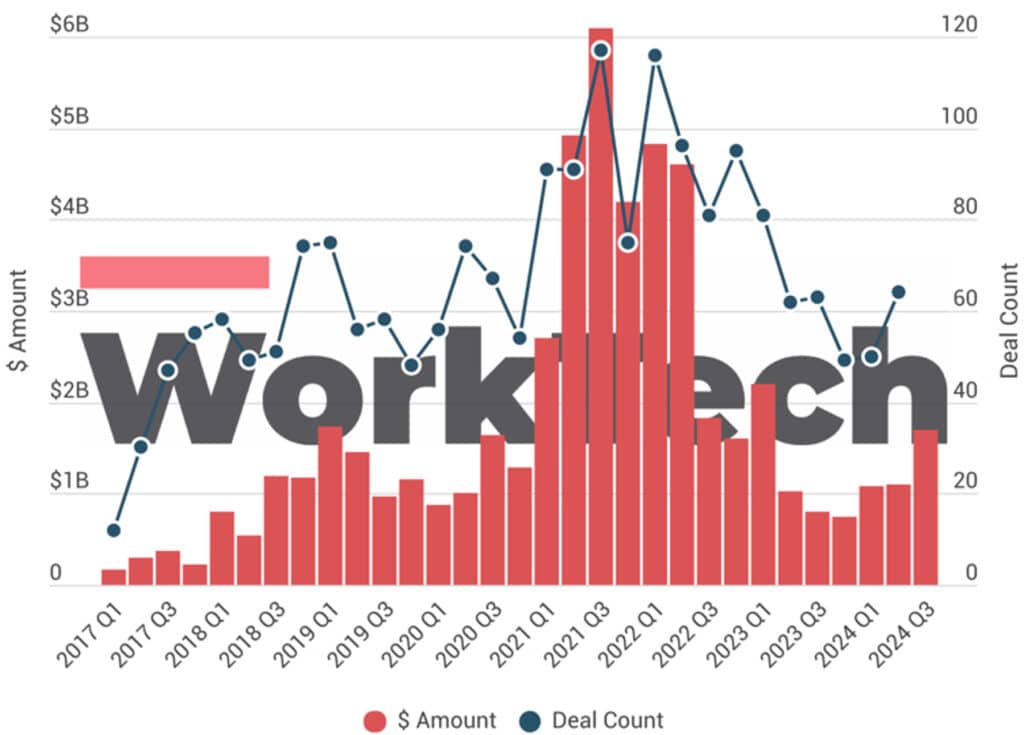
Source: WorkTech, 2024 Q3 Global WorkTech VC Update**
As to how the year ends, we will have to wait and see – but investment levels in Q3 2024 ($1.7bn through 71 deals) were buoyant compared to Q3 2023**.
By December 2024, ThinkinCircles had identified more than 200 HR & Recruitment technology companies that had received funding in 2024. The particular area of focus of our research is on the journey from Seed to Series A – and the critical role that marketing plays in success. As, we evidence, however, access to and affordability of strategic marketing expertise present challenges for start-up companies.
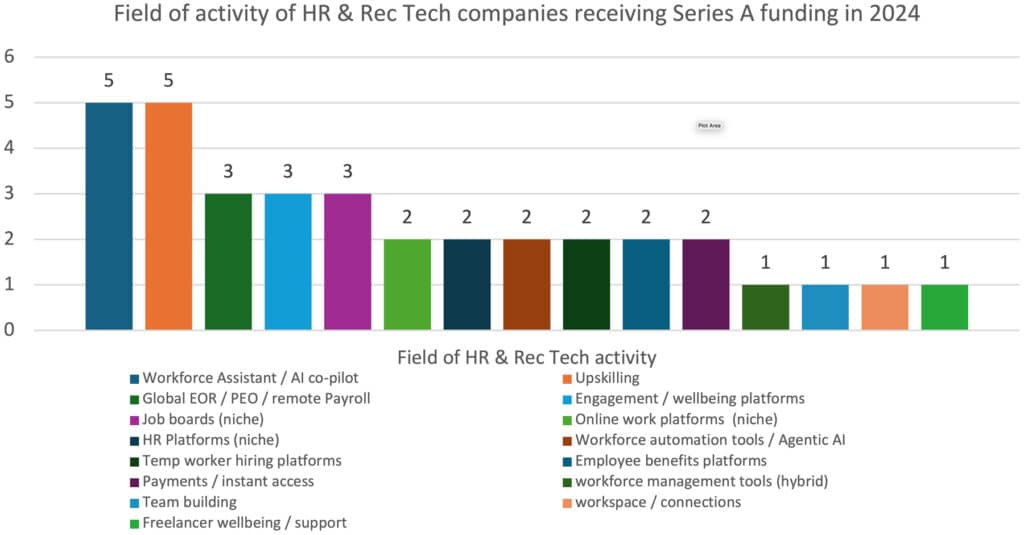
As part of this research, we mapped 35 HR and Recruitment Technology (RecTech) companies who had secured Series A funding in 2024:
- A total of $455.8 was raised by these companies – an average of $13.0m per Series A funding.
- 60% (21) had been founded since the onset of the global pandemic (2020).

Source: ThinkinCircles analysis of publicly available data
- The two most prevalent areas of Series A investment in 2024 were in Workforce Assistant / AI Co-Pilot and Upskilling technologies.
- There was also keen interest in global PEO / EOR / remote worker engagement solutions and Employee Engagement /Wellbeing platforms.
Source: ThinkinCircles analysis of publicly available data
- Between them, these 35 companies had a total visible workforce of 3,539 in December 2024:
- This was an average of 101 visible workers per company.
- Of the visible workers, 4% (159) were marketers:
- All except one Series A funded company had dedicated marketing resource.
- This was an average of 4.7 marketers per Series A company with dedicated marketing resource.
As such, it is clear that by the time Series A funding has been secured, the internal marketing function is quite well established. That said
- Just nine companies (26%) have a senior marketing figure in post:
- Five companies have a CMO (incl. 1 fractional) and four have a Marketing Director.
- Several companies have senior Growth professionals in post.
- Whilst this function often combined sales and marketing, some companies split growth marketing out as a specialism.
- What is also interesting to note is that many CMOs and Growth professionals – notably fractionals – practice exclusively within VC-backed enterprises.
- Of additional note, two companies have advisory boards with CMOs (including fractionals) on them – an additional way of bringing marketing expertise to an organisation without engaging full-time headcount.
We also explored 49 HR and RecTech companies who had receiving Seed funding in 2024:
- Eight in ten (39) had been incorporated since 2020 – and 62% (29) were incorporated in the last 3 years.
- A total of $183.2m was raised by these 49 companies – an average of $4.0m per Seed funding.

Source: ThinkinCircles analysis of publicly available data
- The two most prevalent areas of Seed investment in 2024 were in Workforce Assistant / AI co-pilot and niche online work / hiring platforms / Freelancer Management Systems (FMS).
- There was also keen interest in global PEO / EOR / remote worker engagement solutions, Employee Engagement / Wellbeing platforms and Resource Scheduling / Workforce Management tools.

Source: ThinkinCircles analysis of publicly available data
- Between them, they had a total visible workforce of 1,169:
- This was an average headcount of 24 per company.
- 6% (65) of their visible workers were marketers
- This was an average of 1.8 per company with dedicated marketing resource.
- Crucially, however, 14 companies have no dedicated internal marketing resource.
At this early stage, the marketing function – in companies that have dedicated resource – is sparce, with notably more generalists than specialists:
- Senior figures can be found in just 8% of 2024’s Seed-funded companies:
- Just one has a CMO whilst 3 have a Marketing Director
- It is more typical for these companies to have a Marketing Manager as the most senior resource (found in 31%).
- Six of the companies have Brand Managers, notably focusing on establishing and maintaining partnerships.
Being thin on the ground at this critical stage in a company’s evolution is far from ideal – as, in order to scale from Seed to Series A funding, there are three aspects of marketing that organisations must simultaneously focus on:
- Producing innovative marketing to drive client acquisition:
- Innovation is critical to enable organisations to stand out in a competitive landscape.
- Building a strong Employer Brand to attract top talent:
- Strategic talent acquisition is crucial for product development, growth and investor confidence.
- Honing marketing strategies that will attract investors:
- Demonstrating that the solution is addressing / creating market need. This includes:
- Use of customer advocacy.
- Building market authority.
- Boosting credibility through strategic partnerships.
- Utilising data-driven storytelling.
To do this with such limited resource – as we have evidenced is the reality within most HR & RecTech companies at Seed funding stage – is nigh-on impossible. Similarly, investment in full-time specialists in each facet of marketing requirement is also out of reach of most start-ups at this stage. As such, external support from portfolio fractional marketing specialists such as ThinkinCircles provides an agile and affordable solution to addressing the complex array of marketing requirements faced by companies seeking to move from Seed to Series A funding.
To explore how ThinkinCircles supports growth companies with fractional marketing support, let’s chat.
** WorkTech, Q3 2024 global WorkTech VC – look back, look forward: https://1worktech.com/event/live-q3-2024-global-worktech-vc-review/

Recent Comments